
What is the voltage of a LiPo battery? This is the first question that comes to mind when you look at the numbers like 3.7V, 7.4V, 11.1V, or 22.2V on LiPo battery labels. Actually, LiPo batteries have become the most reliable energy source for many modern devices. These batteries are lightweight, rechargeable, and able to deliver a lot of power.
You can find them in drones, RC cars, RC aeroplanes, robots, and portable electronics. However, for beginners, voltage is often the thing that confuses them, as it is related to battery cells. But in reality, understanding LiPo battery voltage is much easier once you grasp the basics. To make things easier for you, I will discuss LiPo battery voltage and how to measure it in this guide. So let’s get started.
What Is the Voltage of a LiPo Battery?
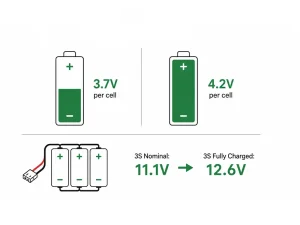
The voltage of a LiPo battery is the amount of electrical power it can provide to a device. It shows how strongly the battery pushes electricity through a circuit. Every LiPo battery has a specific voltage based on the number of cells inside it. A single LiPo cell has a nominal voltage of 3.7 volts.
So basically, the overall voltage of the LiPo battery is the sum of the voltages of all the cells. The higher the number of cells, the higher the overall voltage of the LiPo battery will be. For example, a 2-cell (2S) LiPo battery has a nominal voltage of 7.4V (3.7V + 3.7V). At the same time, a 3-cell (3S) battery has 11.1V (3.7V * 3). This is why LiPo batteries are available in different voltage ratings for different devices.
Knowing the voltage of a LiPo battery is crucial, as every device is designed to operate within a specific voltage range. When you know the basics of voltage, you can choose the LiPo battery that matches your device’s needs. Remember, if you choose a battery with too low a voltage, it will not perform well. However, if the voltage is too high, it can damage the electronics or shorten its lifespan.
Nominal Voltage vs Fully Charged Voltage of a LiPo Battery
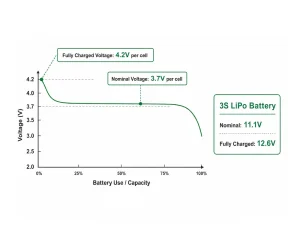
The nominal voltage of a LiPo battery is its normal working voltage during most of its use. On the flip side, the fully charged voltage is the highest voltage the battery reaches after it has been charged completely. A LiPo battery has both of these voltages different because the battery voltage changes as it charges and discharges.
For example, one LiPo cell has a nominal voltage of 3.7V. However, when it is fully charged, this voltage becomes 4.2V. Now suppose you have a 3-cell (3S) lithium polymer battery. Its nominal voltage will be 11.1V. At the same time, its fully charged voltage is 12.6V. This does not mean the battery is faulty. It simply means the battery starts at a higher voltage after charging and slowly drops toward its normal working voltage as you use it.
Does Voltage Affect LiPo Battery Performance? If Yes, How?
The voltage of a LiPo battery plays a major role in the device’s overall performance. First, it affects how much power the battery can deliver and how efficiently the device works. When a battery has the correct voltage for the device, it will run smoothly. However, voltages that are too high or too low reduce the device’s effectiveness.
Secondly, voltage directly affects the speed and strength of battery-powered equipment. For example, you see drones, RC cars, and RC airplanes; they run on LiPo batteries. Here, the LiPo battery with a higher voltage makes the motor spin faster and produce more power. This improves speed, acceleration, and overall performance. However, using a higher voltage is only safe if the motor is designed to handle it. Otherwise, the extra voltage will reduce the life of the equipment.
Quick Highlight: Many beginners think that higher voltage means a longer lifespan of LiPo batteries. However, that’s a wrong concept. The duration a LiPo battery lasts mainly depends on its capacity (mAh). Voltage only affects how much power the battery provides. That’s why, for the best results, you should always choose the voltage that matches your device’s needs.
How to Measure LiPo Battery Voltage Correctly?
When you buy a LiPo battery, you cannot leave it to work on its own. Instead, over time, checking the voltage of a LiPo battery is important. Why? Because it helps you know the battery’s current condition. By measuring the voltage, you can see whether the battery is fully charged, partly discharged, or needs recharging. Here are a few methods to check the exact voltage of your LiPo battery.
-
Using a Digital Multimeter
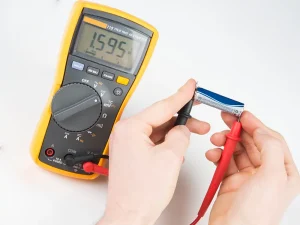
A digital multimeter is one of the most common and user-friendly tools for measuring voltage. It has a red and a black probe and a display screen. To use it, set the multimeter to DC voltage mode. After that, connect the red probe to the battery’s positive terminal and the black probe to the negative terminal. The display will then show the battery’s voltage reading. However, the multimeter shows only the overall voltage of the LiPo battery, not the individual cells.
-
Using a LiPo Battery Checker
A LiPo battery checker is a small device designed specifically for LiPo batteries. You have to connect it directly to the battery’s balance connector, and it will instantly show the voltage. Unlike a basic multimeter, a LiPo checker shows both the total battery voltage and the voltage of each cell. This is very useful, as if one battery cell has a much lower voltage than the others, the checker can help you identify the problem early.
-
Using a Smart Charger
The last method for measuring the voltage of a LiPo battery is to use a smart charger. These chargers are beneficial in two ways. First, they measure the voltage with higher accuracy. At the same time, they also monitor the battery in real time. When a battery is connected, the charger displays the total voltage, individual cell voltages, and charging status. This continuous check helps you detect whether all cells are charging evenly. If not, this charger can automatically balance the cells as needed.
What Is the Safe Voltage Range for a LiPo Battery?
A LiPo battery works best when its voltage stays within a safe range. This safe range includes both charging and discharging voltage. So, for a standard LiPo battery, each cell reaches 4.2V when fully charged. This is the highest safe charging voltage. Similarly, when the battery is not in use for a long time, it is best to store it at about 3.8-3.85V per cell.
This is called the storage voltage. Remember, storing a LiPo battery fully charged or nearly empty for an extended period can shorten its lifespan. During use, you should also avoid letting the voltage drop too low. A LiPo battery should generally not go below 3.0V per cell. If it drops below its safe voltage limit, it will take a long time to recharge. Over time, this over-discharging can damage the cells.
What If the Voltage Is Too High or Too Low?
As I said above, a LiPo battery is designed to work within a specific voltage range. Going beyond that safe limit creates several problems. There are two situations. The first one is when the voltage is too high. Too high a voltage means the battery has been overcharged. Overcharging can make the battery heat up, swell, or lose its ability to hold a charge.
In serious cases, it can even create a fire risk or burst, which can cause injuries to nearby persons. On the other hand, if the lithium-ion battery voltage is too low, it indicates that the battery is over-discharged. This discharging might seem normal. But over time, it reduces the battery capacity. After that, it becomes difficult to recharge and permanently damages the battery cells.
LiPo Battery Voltage Chart You Must Understand
There is a wide range of LiPo batteries that come with different voltage levels. So understanding them individually can become difficult for many beginners. That’s why understanding all voltages of some common LiPo batteries is helpful. Here is the table that will help you.
| LiPo Battery | Nominal Voltage | Fully Charged | Storage Voltage | Minimum Safe |
| 1S | 3.7V | 4.2V | 3.8–3.85V | 3.0V |
| 2S | 7.4V | 8.4V | 7.6–7.7V | 6.0V |
| 3S | 11.1V | 12.6V | 11.4–11.55V | 9.0V |
| 4S | 14.8V | 16.8V | 15.2–15.4V | 12.0V |
| 5S | 18.5V | 21.0V | 19.0–19.25V | 15.0V |
| 6S | 22.2V | 25.2V | 22.8–23.1V | 18.0V |
Factors That Can Affect LiPo Battery Voltage
The voltage of a LiPo battery does not always remain constant. Instead, it changes with several factors. Knowing those factors is very crucial to using your battery more safely and recognizing normal voltage changes. Below are some of the main factors that affect LiPo battery voltage.
- Number of Cells: The biggest factor that has a direct effect on LiPo voltage is the number of cells. Each LiPo cell has a nominal voltage of 3.7V. So if your battery has more of these cells, its voltage will increase, and vice versa.
- Battery Charge Level: The battery’s voltage changes as it charges and discharges. When a LiPo battery is fully charged, each cell reaches 4.2V. As you use the battery, the voltage slowly drops as energy is consumed. Now you can check this voltage to know whether the battery is fully charged, partially charged, or needs charging.
- Temperature: Varying temperatures also affect LiPo battery voltage in many ways. In cold weather, the battery often shows a lower voltage and delivers less power. Why? Because the chemical reaction inside the battery slows down. Too-cold weather also affects this voltage. So a LiPo battery works best under its recommended temperature range.
- Battery Age: As a LiPo battery gets older, its performance gradually decreases. Right? After many charging and discharging cycles, the battery cells begin to wear out. Now it can no longer hold as much energy as it did when it was new. As a result, the voltage may drop more quickly during use.
- Load on the Battery: Lastly, the amount of power a device uses also affects its voltage. If it needs more power to work, the battery’s voltage quickly drops temporarily. Once the heavy load is reduced, the voltage often increases again.
Conclusion
LiPo batteries have become a favored choice for many of the devices we use every day. However, when it comes to their voltage, many get confused. That’s why, in this guide, I have discussed the voltage of a LiPo battery. Actually, the voltage is the power that a battery delivers. It is directly related to the number of cells. In LiPo batteries, several cells are connected in series. A single standard cell has a voltage of 3.7V. So, the more cells, the higher the battery voltage. But when the battery is fully charged, its voltage changes. Understanding all this helps you run your device effectively. This basic idea helps you avoid common mistakes and use your battery more confidently.