







How to choose the right forklift battery? That’s the question when someone faces a battery issue in their forklifts. I know the wrong battery can do more harm than good in the forklifts. Remember, forklifts require high power from the battery.
If you choose a low-quality battery, it won’t run the forklift smoothly. The selection process becomes tedious when you hear other forklift owners’ opinions. But you don’t need to worry; this article will help you choose the right forklift battery that fits your vehicle’s needs. I will also discuss why battery selection matters in the forklift. So, let’s begin!
Why Choosing the Right Forklift Battery Matters?
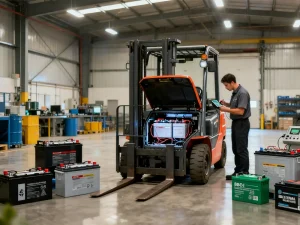
Before discussing tips on choosing a forklift battery, let’s first understand the importance of a good battery. If you make the mistake of choosing the wrong battery, the performance of your forklift will degrade. Here are some reasons why I stress the right forklift battery:
- Power Supply: Although a forklift may seem compact, it needs lots of power to lift heavy materials. So, the battery must be strong enough to supply that power to the forklift’s motor. Low-quality batteries drain out quickly when a forklift needs more power.
- Charging Speed: Some forklift batteries charge very slowly. Choosing such a battery will affect the efficiency of your forklift. Good batteries charge quickly to ensure no downtime and smooth operation.
- Lasting & Lifespan: Quality forklift batteries always last longer. They offer more forklift runtime on a single charge and more charge cycles, ensuring a longer lifespan. Buying such a quality battery keeps you from hassle or regular replacement for a long time.
- Severe Heating Issues: Have you ever seen a forklift battery? That’s because people use cheaper batteries, which overheat quickly when forklifts are operating. A quality forklift battery never overheats and performs better on hot summer days. Choosing the right battery is essential for the safety of forklift operators.
- Voltage Drop Issue: There are multiple very cheap batteries. However, they pose a serious voltage drop issue, making them unfit for a forklift. Such batteries provide high voltage at first. But when the forklift keeps running, the battery discharges, and its voltage does not remain steady. As a result, they stop powering the forklift even if they are not fully empty.
How to Choose the Right Forklift Battery?
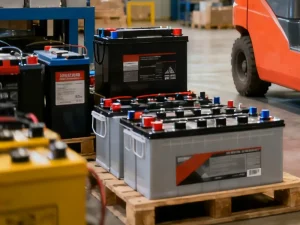
High-quality batteries make forklifts handy vehicles for different sectors. However, if the battery used in this vehicle is of low quality, it makes the forklift trash. Why? The forklift won’t be able to perform its role due to consistent issues. In the section below, I’ll discuss how you can choose the right forklift battery. So, let’s begin!
1- Forklift Specifications or Requirments
First, the selection of a forklift battery should always start with the specification. You should check the voltage requirement for the forklift’s operation. Different types of forklift batteries, 24V, 36V, and 48V, are available in the market.
You should choose a battery whose voltage matches the specification of your forklift. Choosing a battery with the wrong voltage specification won’t perform excellently in a forklift. It is noteworthy that electric forklifts have a specific box or compartment for battery placement. Your chosen forklift battery should ideally fit in that compartment.
2- Operating Hours of Forklift
How many hours do you use your forklift? Is it used for a few hours a day or runs 24/7? Knowing the answer to these questions helps choose the right forklift batteries. If you run a forklift a few hours a day, you can select a battery with a slow charging speed. Once you park your forklift, the battery will start to charge.
In such a case, the lead-acid battery is suitable as it is cheaper and charges in 8 to 10 hours. However, if you use a forklift for more than 15 hours, that’s a complex situation. In such a case, you should buy a forklift battery that can charge quickly. I recommend buying lithium batteries, which can be charged in less than 2 hours.
3- Charge Cycle & Lifespan
Ideally, you should choose a forklift battery with a higher charge cycle. Don’t you know what a charge cycle is? It refers to a single charge and then a complete battery discharge. I recommend choosing a forklift battery with a charge cycle of over 2500.
Such batteries last longer, and you won’t have to replace them quickly. There are batteries in the market with a charge cycle below 1500. The best example of such batteries is lead-acid batteries. You should avoid choosing such cheap batteries. Remember, the higher the charge cycle, the longer the lifespan of the forklift battery and vice versa.
4- Capacity (Amp-Hour Rating)
Another key factor you must consider is the capacity of the forklift battery. This capacity is indicated in Amp-Hours and refers to energy stored in the battery. The higher the capacity, the more energy will be stored in the forklift battery. More energy storage means your forklift will run for a longer time on a single charge.
It is noteworthy that forklift batteries with higher capacity are generally more expensive. Therefore, I recommend analyzing your forklift usage hours. If you use your forklift a few hours a day, a battery with less capacity is all good to go. Such batteries are inexpensive and can power the forklift for 3 to 5 hours. If you use a forklift for over 12 hours a day, I recommend opting for a battery with higher capacity.
5- Charging Time and Method
Forklifts are used because they enhance productivity. Right? They help lift, carry, and transport heavy material quickly. But what if their battery takes 10 to 12 hours to charge? That would affect the operation of the forklift. Why? Because when the battery is charged, your forklift will be parked. You’ll have to wait for hours for it to charge.
Therefore, I recommend choosing a forklift battery with quick charging. These lithium-ion batteries come with fast charging and take 2 hours to fully charge. Using such batteries will ensure no downtime in the forklift’s operation. Additionally, you should also choose the charger compatible with your battery. The wrong charging method can be harmful to the forklift battery.
6- Steady Voltage & Performance
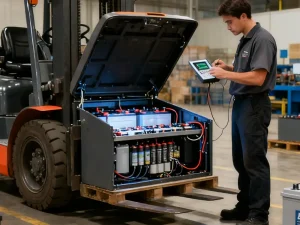
You should choose a forklift battery that provides steady (stable) voltage. Remember, each forklift operates at a specific voltage. If the battery does not provide that voltage, the forklift won’t work at all. There are cheap batteries that fail to provide a steady voltage. When they are fully charged, they provide high voltage. But as they discharge, they undergo voltage drop issues.
As a result, the forklift may fail to operate smoothly. The best example of such cheap batteries is lead-acid batteries. I recommend choosing a high-quality lithium-ion battery for the forklift. Why? They maintain a steady voltage regardless of whether they are entirely or half-charged. Remember, steady voltage from the forklift battery also improves the performance of the forklift.
7- Safety & Regular Maintenance
I always focus on choosing safe forklift batteries. Why? The safety of the battery is linked with the safety of the forklift. If you choose a low-quality battery, it would pose heating issues. Due to overheating, the battery can catch fire, affecting the forklift. I recommend lithium batteries because of their safety, as they do not overheat..
You should not consider lead-acid batteries, as they commonly experience heating issues. Instead, you should choose a perfectly sealed forklift battery. This ensures no electrolyte leakage, which could make the forklift messy. Remember, low-quality forklift batteries require regular maintenance, resulting in a higher maintenance cost.
8- Cost (Upfront vs Long Run)
The cost of the battery holds key value when it comes to forklift battery selection. Right? You’ll see inexpensive forklift batteries. However, their long-term cost makes them unsuitable for forklifts. Why? They require regular maintenance, which adds to their cost. Additionally, they degrade quickly, requiring you to replace them in 2 to 3 years.
On the other hand, there are very expensive batteries (lithium-ion). However, such forklift batteries do not require regular maintenance. Additionally, they can last for over 10 years, so you won’t have to replace them quickly. I recommend you choose such forklift batteries as they are cost-effective in the long run.
Standard Forklift Batteries You Can Choose
In a previous article, I compared lead-acid and lithium-ion forklift batteries. I recommend reading that guide if you don’t know about basic forklift batteries. Remember, lead acid and lithium-ion batteries are commonly used in forklifts. Let’s have a bird’s-eye view of these two forklift batteries. For more details, I highly recommend reading our previous article, in which we compared both of these batteries.
1- Lead Acid Batteries
Lead-acid batteries are popular because of their affordability. However, their performance is very compromised, especially if they are used for forklifts. Why? First of all, the charging speed of lead-acid batteries is very slow. It might take even more than 10 hours to fully charge. This means that when your forklift discharges, it will be stopped for around 10 hours.
That’s big downtime, resulting in less efficiency from the forklift. How can we forget those heating issues? The lead-acid batteries don’t come with an advanced BMS system. During charging, they overheat and can catch fire in extreme cases. Lead-acid forklift batteries offer a maximum of 1500 charge cycles, which makes them less long-lasting.
Leakage in these lead-acid batteries is very common. As a result, they make your forklift dirty and messy. I don’t recommend this forklift battery due to its poor performance. However, if you’re someone with a tight budget and use a forklift occasionally, this battery type can be your fit.
2- Lithium Ion Batteries
Lithium-ion batteries are advanced and the most popular option for forklifts. As I said earlier, forklifts require high power, especially when lifting heavy-duty materials. So, the battery should be strong enough to provide the required power. These lithium-ion batteries are the perfect match as they supply the required power without showing a voltage drop.
What makes lithium-ion batteries stand out for forklifts is their high energy density. This means that they can store more energy despite their compact size. So, they deliver more power to the forklift for longer, and don’t drain out quickly. The life of lithium batteries is another plus point for forklifts. These offer around 4500 charge cycles; you can use them in a forklift for over 10 years.
In busy places, the forklift needs to stay active most of the time. Right? If a forklift takes more time to charge, it can affect its uptime. However, these lithium batteries can be charged quickly in less than two hours. It means you won’t have to stop the forklift for a long time to charge. The only drawback you’ll face in these lithium batteries is their higher pricing. If you want performance from your forklift, these lithium-ion batteries are worth their higher pricing.
Conclusion
I know that choosing forklift batteries can be challenging. There are many factors that one must consider when choosing a quality battery. A small mistake can lead to buying a battery that does not fulfill the power needs of the forklift.
In this article, I’ve discussed key factors that will help you in the selection process. Ultimately, you’ll also learn about the two most popular forklift batteries. Lead-acid batteries are suitable if you prefer budget friendliness. On the other hand, lithium-ion batteries are ideal for forklifts, as they are used more extensively.